


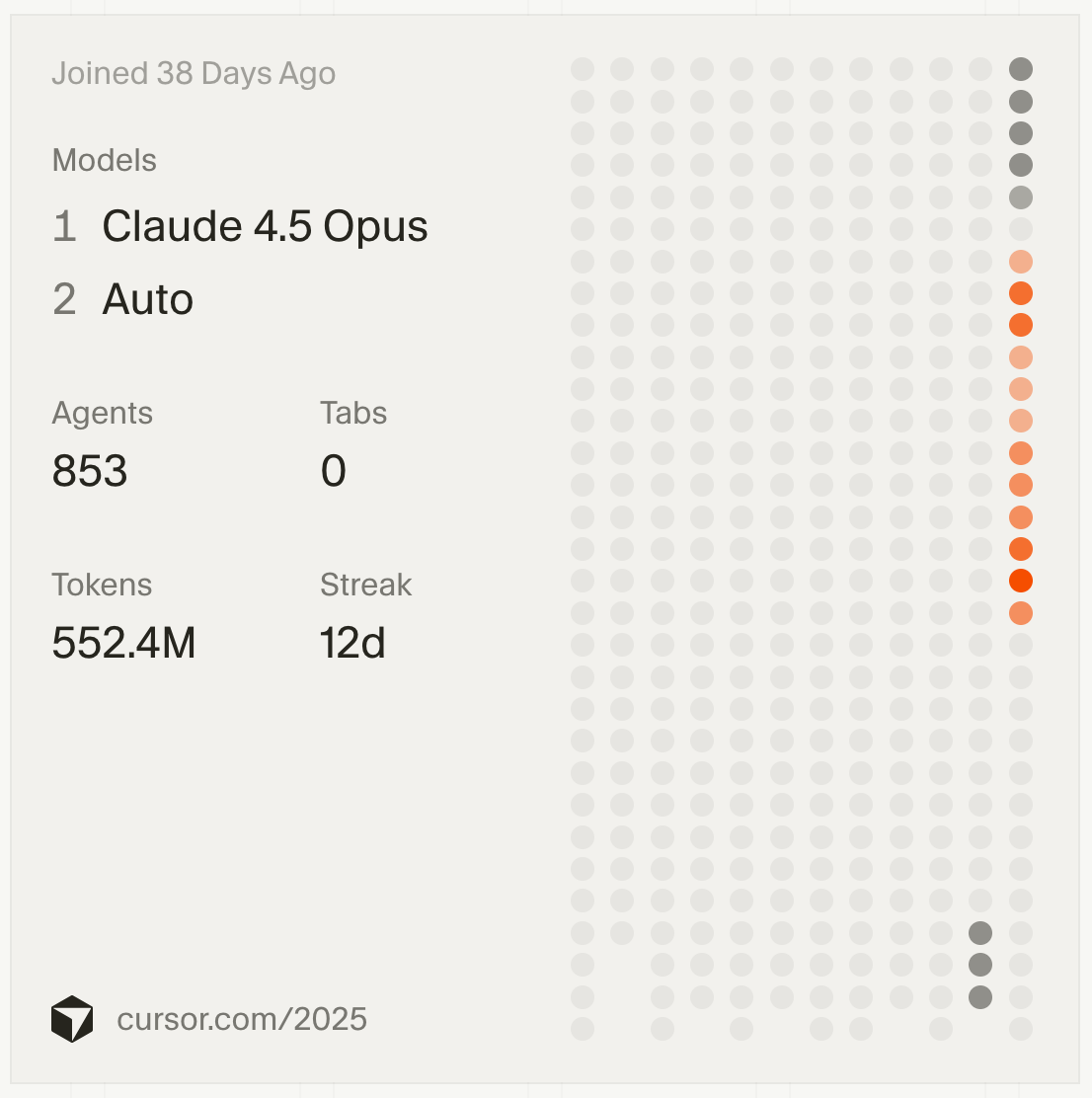
Since starting this no-code experiment, my stack and ambitions have both evolved considerably. If you’d told me 20 days ago—552,408,630 tokens, 853 messages, and 154 chats ago—that I’d be building not just websites, but my own AI-powered forecasting tool, I’m not sure I would have believed you.
The early parts of this journey were about getting things live: standing up sites at speed, learning the quirks of Cursor, Sanity, and Vercel, and pushing through the ever-present “You are out of AI credits” warnings. But now, I’m aiming higher: turning ideas into products that go beyond static content, using AI to create entirely new insights.
Opus 4.5: The Coding Workhorse
As I deepened my work, one tool stood out: Opus 4.5. Out of all the models and AI assistants I’ve used, Opus 4.5 is unrivaled for complex coding tasks—it produces high-quality results with a minimum of back-and-forth. When I see that particular model is active, I know real progress will get made.
Introducing SnowSure: From Website Builder to AI Product Creator
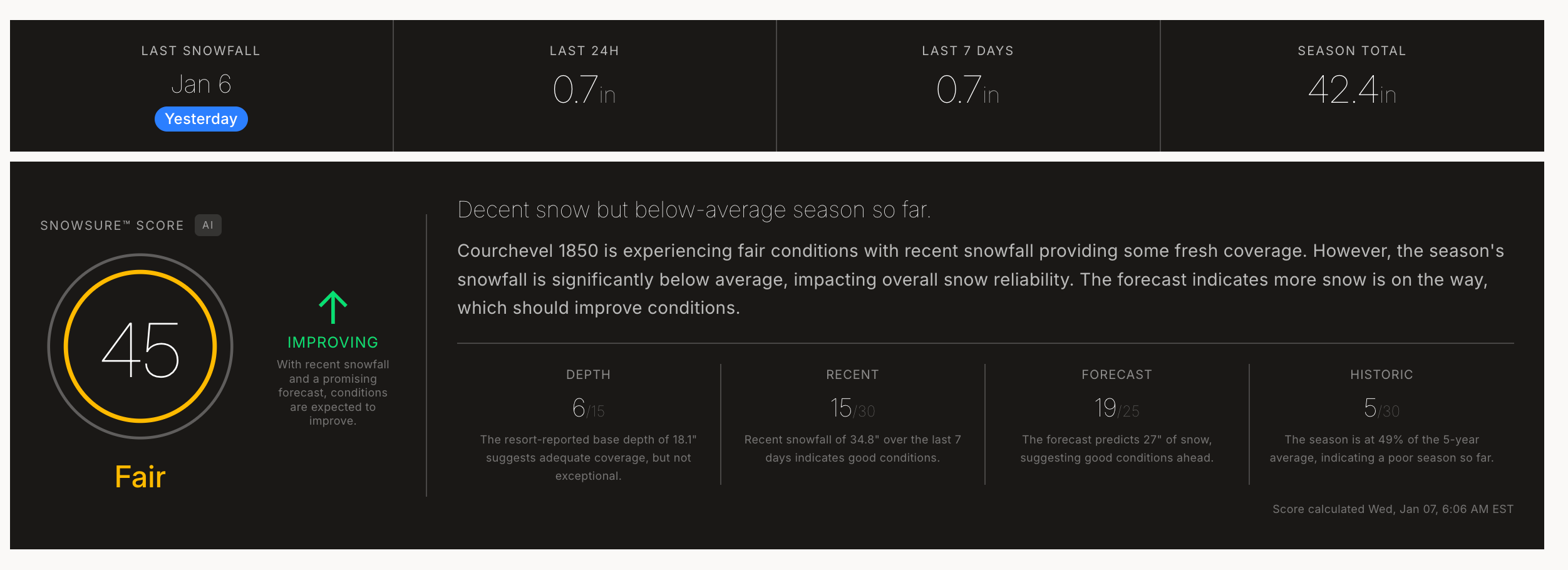
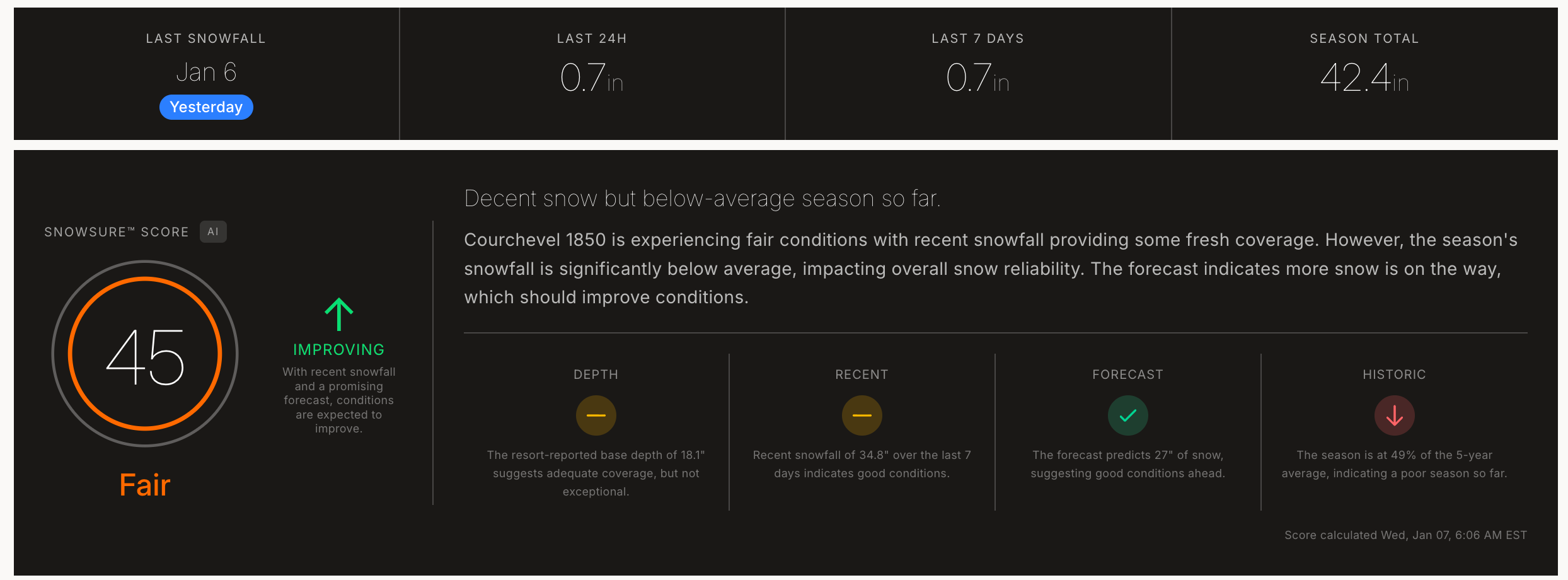
My latest project is SnowSure (website is not live yet). The idea is simple, but the execution is complex: generate a “SnowSure Score” for ski resorts that rates and predicts the reliability of snow for would-be travelers. Existing snow forecast sites are plentiful, but none offer forward-looking, historically-aware AI insights tailored to help users plan travel with genuine confidence in snow conditions.
The aim: integrate multiple weather data sources and statistical models, and feed everything into an AI-powered layer to output a SnowSure Score that’s actually useful.
Weather Data Wars: API Integration and Model Selection
My first step was researching the best weather data providers and models. Instead of just relying on third-party sites like OnTheSnow or SnowForecast, I set out to build my own data-driven solution using open APIs. I learned about and experimented with:
Open-Meteo: My mainstay for both forecasts and historical weather data. Their API is straightforward and the upgrade to Pro ($99/mo) grants access to deep historic records and 1 million calls per month.
Visual Crossing: Another strong candidate for forecasts and historic data, still under evaluation.
Meteomatics API, OpenWeatherMap, Tomorrow.io: Each has its strengths and frustrating limitations—Tomorrow.io, for example, is difficult to even sign up for as a solo developer.
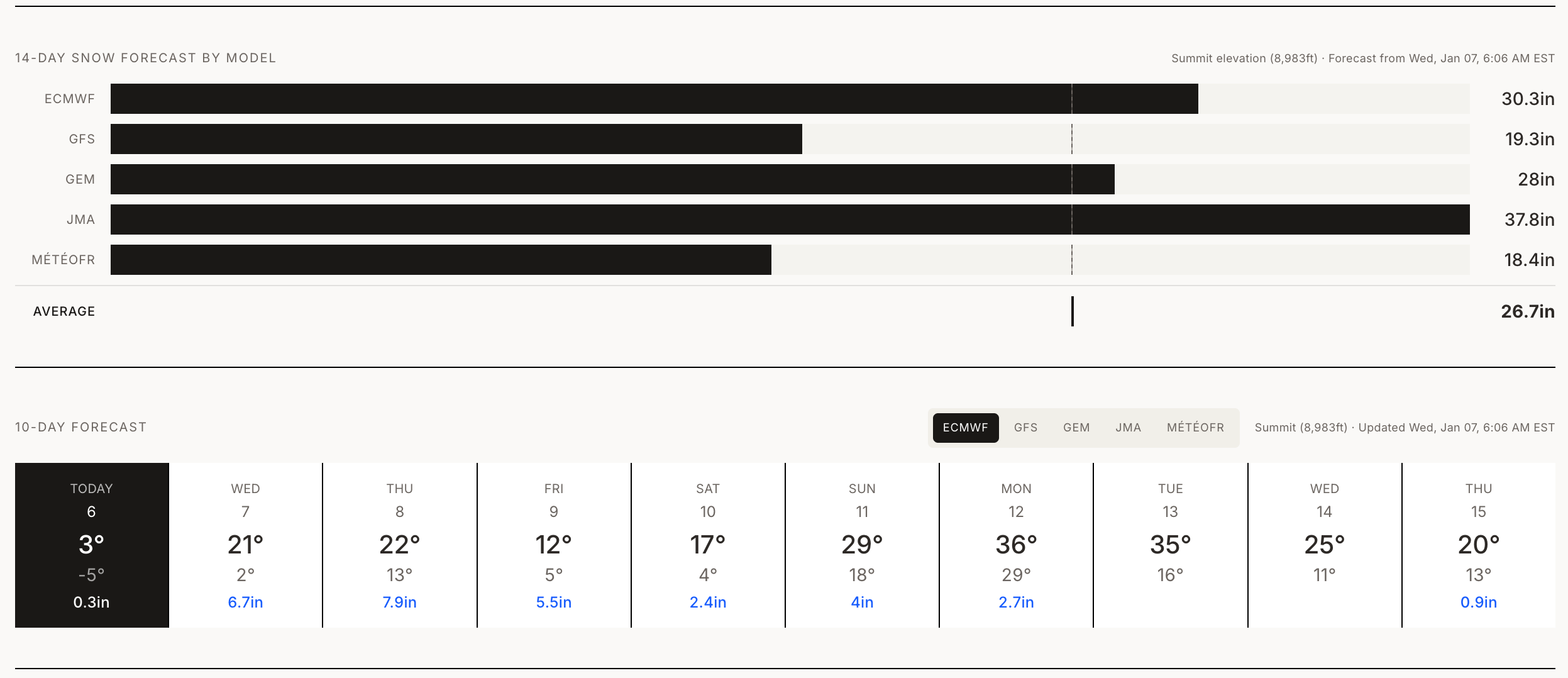
Open-Meteo stands out for sheer accessibility. Their API includes models like ECMWF, GFS & HRRR, Météo-France, DWD ICON, GEM, JMA, and Met Norway, all under one umbrella.
I learned that the real challenge isn’t just in capturing data—it’s figuring out which source is most accurate for each region and integrating them cleanly into my stack.
Building the SnowSure Engine: Airtable, AI Workflows, and Cronjobs
The data pipeline starts simple: fetch weather data via API and store it in Airtable. Airtable’s Omni AI and field agents are fantastic for finding and organizing data, though they tend to overbuild features I don’t need. From there:
Weather data is pulled and updated via a Vercel cronjob every hour.
I’ve experimented with using Airtable alone or moving heavier loads to a Vercel database if things scale up.
AI reasoning and SnowSure insights are generated using GPT-4o, orchestrated by Cursor—for all the coding, logic, and automation.
The result? In just a few hours, I’d created:
Automated daily weather descriptions.
Current and historical snow conditions.
14-day and 10-day multi-model snow forecasts.
Historical trend analysis.
A dynamic leaderboard—deepest snow base, most snow this season, most snow in 24 hours, and forecasted snowfall leaders.
All of this updates automatically and is ready for further analysis and visualization.

The SnowSure™ Travel Date Predictor
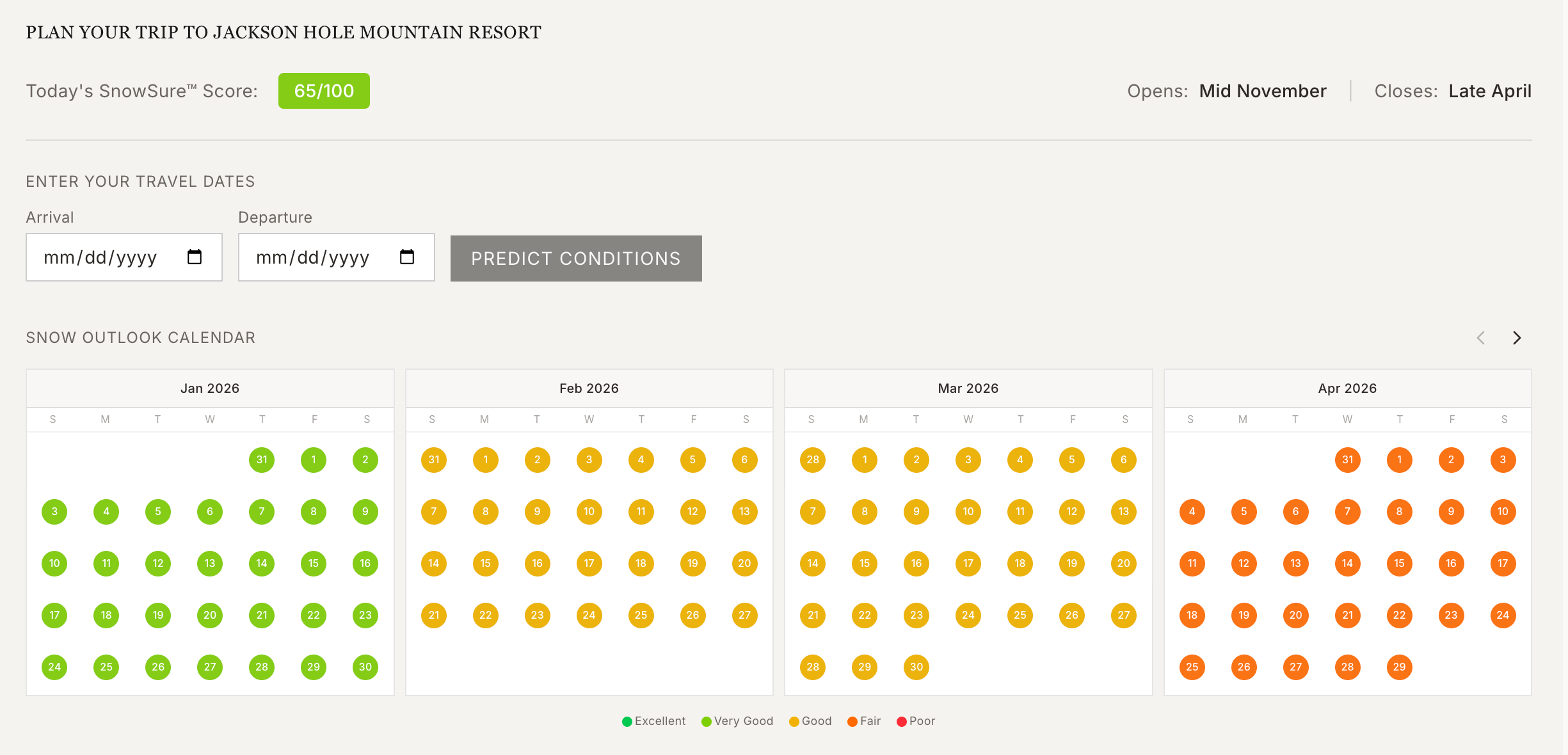
The centerpiece of the project is the SnowSure Travel Date Predictor—a component that lets users select dates, receive personalized snow reliability scores, and see recommendations for the best days to go.
Key features:
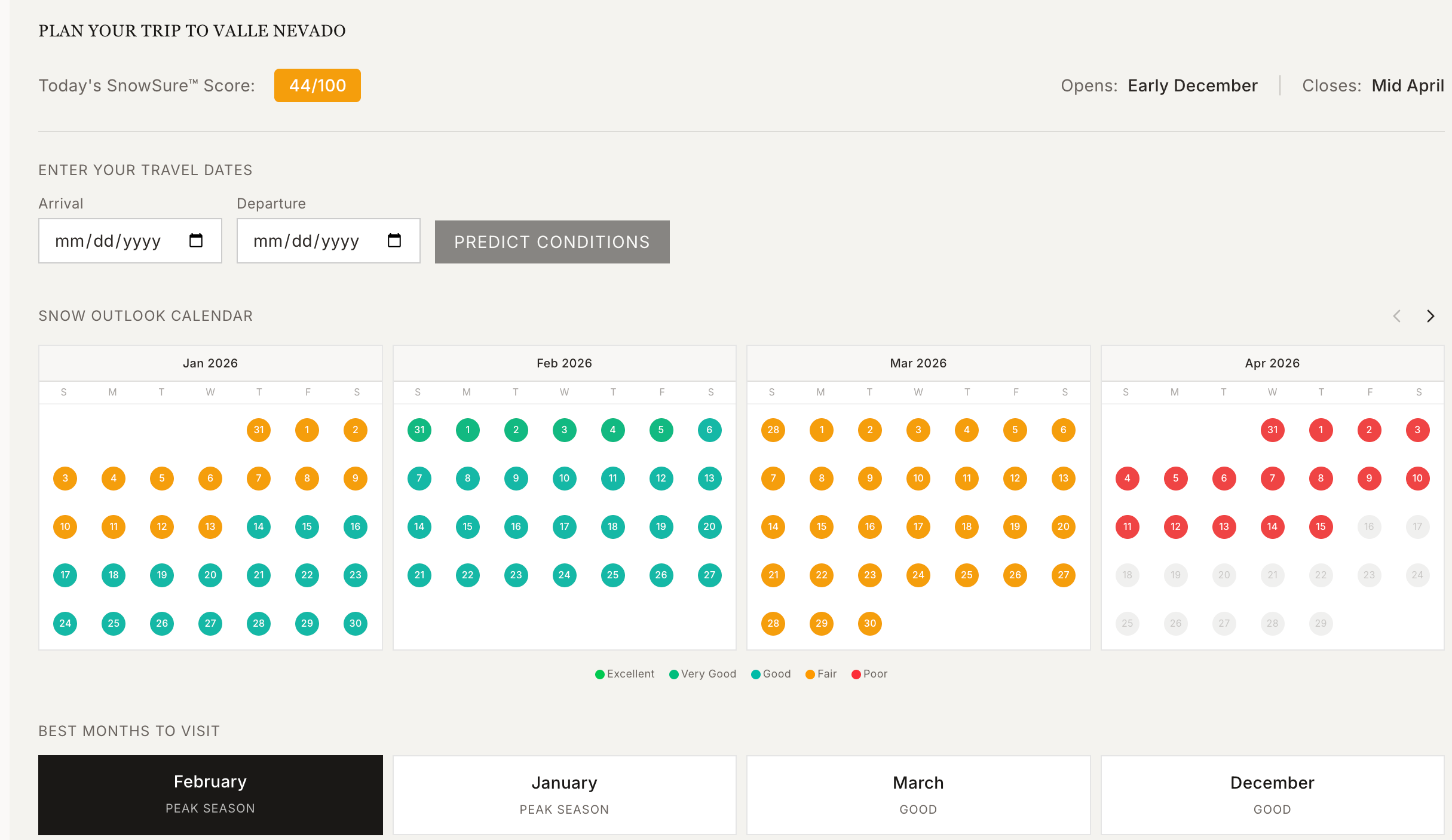
Color-coded calendar showing predicted SnowSure scores for each day (green for excellent, red for poor).
Date picker for users to enter their travel window and see tailored advice.
Highlights of best months to travel, based on historic patterns for each region (Alps, Rockies, Japan, Scandinavia).
Confidence indicators (high, medium, low) based on how close the dates are and how much of the prediction relies on current data versus historic trends.
The scoring algorithm blends:
Actual forecasts for the next 14 days,
Blended forecasts and historical data for days 15–30,
Purely historical performance for 30+ days out.
It looks at monthly region averages, season performance vs. five-year averages, and the latest 14-day forecast to paint a nuanced picture.
Data Accuracy, AI Limitations, and Lessons Learned
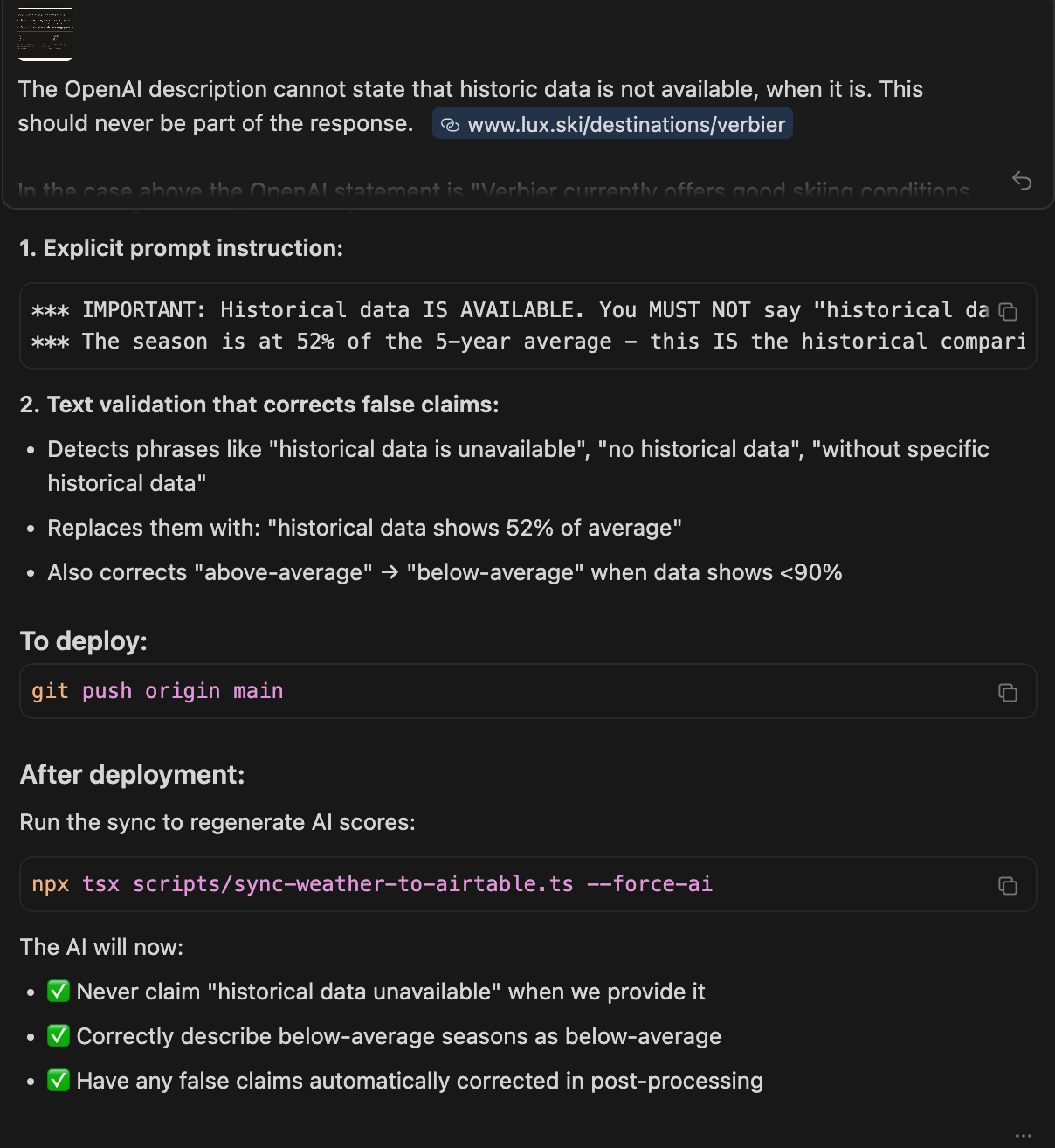
Of course, this adventure hasn’t been frustration-free. I’ve run into familiar struggles: data gaps, inaccurate snow depths (city vs. mountain base discrepancies), vanished API endpoints, token limits reached, and the occasional hallucinated answer from the AI.
Cursor remains the best productivity tool I’ve ever used, but even it forgets choices—like moving image hosting to Sanity CDN (since Airtable’s image URLs expire rapidly). I have to remind it of these decisions, just as I would a team member at a handoff or after a weekend away.
Getting accurate, comprehensive snow depth across resorts is its own continuing battle. Many times, no single provider has all the data, so I blend USA, Europe, and custom-fetched results with Airtable field agents.
And, of course, I continue to get “You’ve run out of credits” warnings everywhere. This is the new currency.
Vision, Impact, and the Power of Experimentation
My wife jokes I should starting learning a tangible trade like construction (she has many projects around our house that she wants me to finish) instead of spending late nights on AI forecasting. Maybe she’s right… or maybe not. This whole chapter feels like the early days of the web—new territory, huge promise, and lots of skeptics.
I built (hired a development company) a crude snow reporting system back in the late ’90s for $15,000 and a month of dev time. Today, I’ve created something vastly more powerful in less than a day, using tools and credits worth a fraction of that.
I’m sharing these learnings at work, too, where my day job as VP of Product in travel tech is directly benefitting from the pace and creativity that AI has unlocked. I’m testing AI-driven improvements on internal tools where risk is low and upside is huge.
Will SnowSure be a commercial product or just a hobby? Too soon to tell. But the journey—the hands-on experimentation, rapid learning, and tactical wins—is what really matters.
Here’s what I’ve come to realize:
“Success is a journey, not a destination. The doing is often more important than the outcome.”
—Arthur Ashe
AI won’t replace people. Instead, it makes us quicker, bolder, and more creative—if we’re willing to guide it. Some days, you’re the pilot steering the project. Other days, you’re reminding your AI co-pilot about choices it keeps forgetting. Either way, it’s not slowing down anytime soon—and neither am I.
Note: I’ll be sharing the website and URL when I feel the project is production and primetime ready. It is one thing to bring an idea or concept into the world, it is another thing for it to be ready for the world to use it. ; )