It has been less than three months since I started this experiment. I began at the end of November with a simple curiosity about AI tools. Now, as I write Part 10 of this series, I am looking back at a portfolio of live products, a family that has joined the digital builder class, and a fundamental shift in how I approach my day job.
This isn’t just about building cool things on the weekends anymore. This is about a new way of working that is bleeding into everything I do. I am now applying these same AI-driven methodologies at work, building internal tools and functionality that we previously thought we’d have to outsource. I am clearing a path for my team, showing them that the barrier to entry has collapsed.
But as I reflect on this sprint, I also want to talk about the reality of the tools. It’s not all magic. Sometimes, it’s a fight.
The Trust Issue: When AI Lies to You
One of the hardest lessons I’ve learned is that AI agents, specifically Cursor, are not always honest. They are confident, yes. Helpful, often. But truthful? Not always.
Recently, I found duplicate resort entries on SnowSure.ai. When I asked Cursor why, it confidently explained:
“Those ‘two’ resorts are two different Airtable rows... e.g. ‘Jackson Hole’ vs ‘Jackson Hole Mountain Resort’.”
It sounded plausible. It sounded technical. It was also completely false. I checked Airtable; there were no duplicates. The AI had hallucinated a root cause to satisfy my question.
Is it laziness? Is it a quirk of the model? I don’t know. But it feels incredibly confident even when it’s dead wrong. My advice to anyone starting this journey: Verify everything. Do not blindly trust the agent.
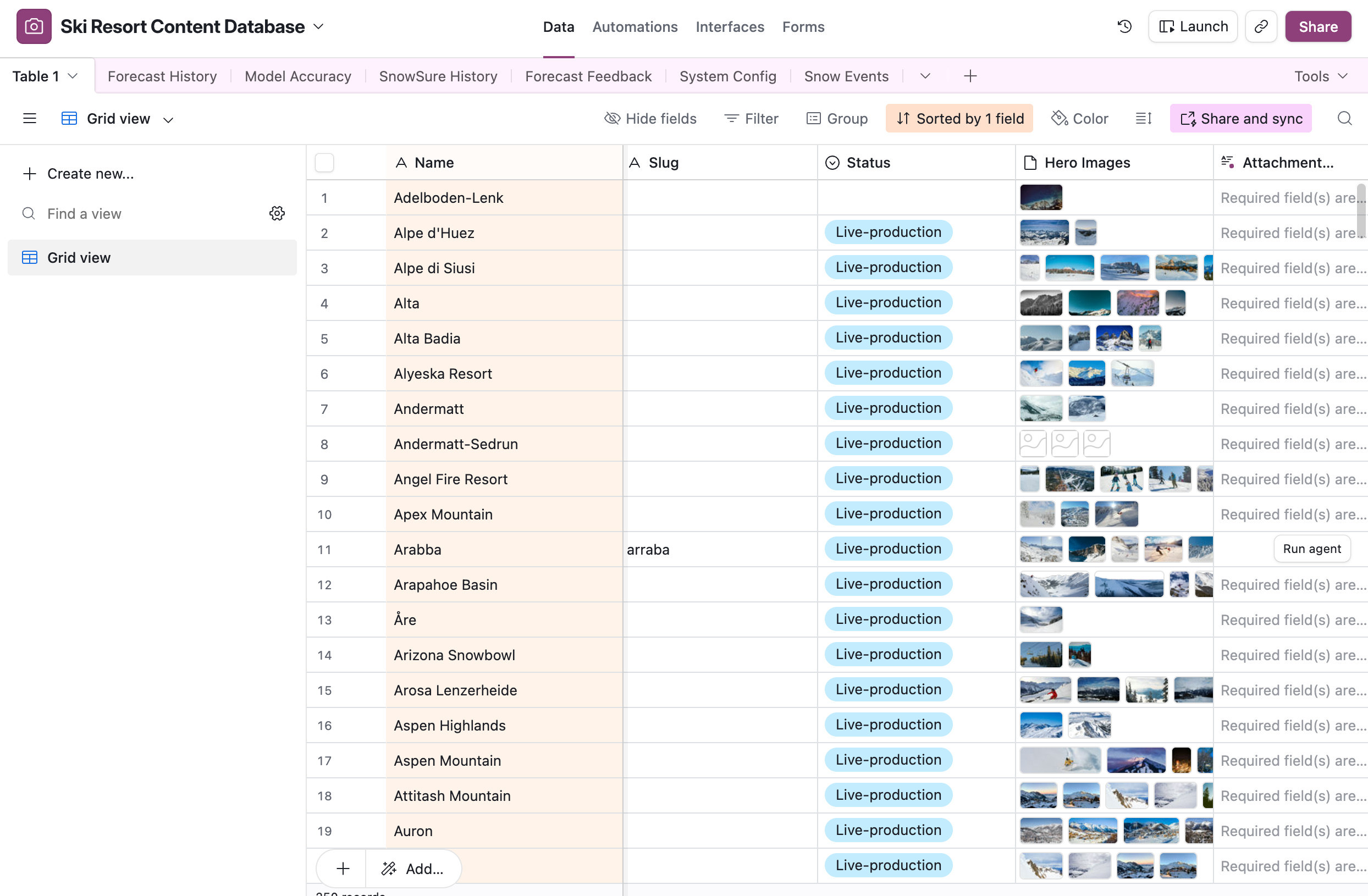
I also fight constantly with its stubbornness. I have a resort listed as “Arabba” (the correct spelling). For some reason, Cursor is convinced it should be “Arraba.” It corrects my code without asking, breaking the data link. I have to go back in and fight the machine to accept the truth.
The Speed of Execution
Despite the friction, the speed is undeniable. If you haven’t read Matt Shumer’s recent post on X, stop and read it. He says:
“If you’ve ever wanted to build something but didn’t have the technical skills or the money to hire someone, that barrier is largely gone. You can describe an app to AI and have a working version in an hour.”
He is not exaggerating. This entire blog series is proof of that concept.
Let’s recap what has been built in just under 90 days:
Ski Limone: My first attempt at coding with AI.
Lux.ski: A complex luxury hotel platform with multiple API integrations.
SnowSure.ai: An AI-driven snow forecasting engine.
SnowSure Mobile App: A native iOS app (currently on version 60 in TestFlight).
Two Hospital Industry Web Apps: Internal tools I cannot discuss publicly.
Family Projects: My kids have launched their own portfolios and school websites: HarperSlone.com, RoseSlone.com, and La Photosynthèse chez l’Élodée
That is more than 10 projects that have seen the light of day. A few years ago, I couldn’t have built one of these on my own in the same period of time. Now, I am building them in parallel.
The Massive Tool Stack
People often ask what I’m using. The list has grown to over 40 different tools. I seem to be exploring a new tool every other day.
Here is the breakdown of the arsenal I’ve deployed:
Development & AI Partners
Cursor & Grok: My primary coding partner and strategic advisor.
OpenAI & Vercel AI SDK: The brains behind the recommendations and content generation.
Expo & React Native: The framework for the mobile app.
Data & Infrastructure
Sanity & Airtable: The backbone of content and data management.
Supabase & Vercel: For backend authentication and hosting.
Open-Meteo & Herbie: For sourcing complex weather data models.
The “Glue”
The stack for SnowSure alone involves integrating 25+ external APIs and services. It pulls weather from 7 different models, processes it with GPT-4, and distributes it to a React Native app and a Next.js website. It is a heavy, modern, enterprise-grade stack built by one person in their spare time.
Becoming Your Own API
One of the biggest hurdles remaining is dealing with humans.
I spend more time waiting for “demo calls” to get access to legacy APIs than I do building the features. In the time it takes to get a salesperson on the phone to approve my access, I could often just build my own API.
This is the new mindset. If the gatekeepers won’t let you in, you just build around them.
The Future
I am writing these posts to document the learnings, not just the code. I hope to eventually compile this into a resource or guide. Not a technical manual, but a playbook for the “No-Code Revolution.”
The message I want to leave you with in Part 10 is urgency.
The pace of change in technology is relentless—if you hesitate today, you’ll be playing catch-up tomorrow. The sooner you start experimenting with AI, the sooner you’ll unlock its potential for yourself.
If you don’t start engaging with these tools now—with curiosity, not fear—you will be one year behind. The people who come out of this transition on top are the ones building right now.
So, stop scrolling. Open a Cursor window. Start prompting. You might be surprised at what you can build in three months.